
The Next Solo: What Two Black Tech Titans Hear in the AI Revolution
To me, if you said I could have reparations or AI, I would take AI every time. Because if you gave me reparations and I had no knowledge of what to do with it, I would be in trouble. But if you gave me AI, I could figure out a way to get reparations times a thousand.
— Van Jones, "How Black America Can Win with AI," on John Hope Bryant's Money and Wealth podcast, July 2025
Same Tune, Different Keys
Two of the most consequential voices in private equity and enterprise technology have been mapping the same tectonic shift in how software creates value. Charles Phillips, the former CEO of Infor and Managing Partner at Recognize, has articulated a consistent vision across several Bloomberg appearances and industry conversations dating back to 2024. Robert F. Smith, Founder and CEO of Vista Equity Partners, has been developing complementary themes over the same period, most concisely in a recent presentation, “Software’s Next Chapter.” Without coordinating, they've been playing the same tune in different keys, and the convergence of their thinking surfaces a set of leadership insights that extend beyond the tech sector.
Their shared premise is simple on the surface: the SaaS era is giving way to something fundamentally different. Phillips describes it as a shift "from workflow to outcomes." For two decades, enterprise software was basically a digital filing cabinet with instructions, a place to store data, and a way to manage processes. You paid per seat, per user, for access to the tool. Humans still did the work. That model, Phillips contends in a recent Recognize white paper, is under fundamental pressure, especially for simpler applications at the bottom of what he calls the SaaS pyramid, even as mission-critical platforms at the top grow more entrenched. In the AI era, software doesn't just support tasks. AI, via agents, can perform the tasks. The "service" in Software-as-a-Service is being reborn, not as a license to use a tool, but as the delivery of results.
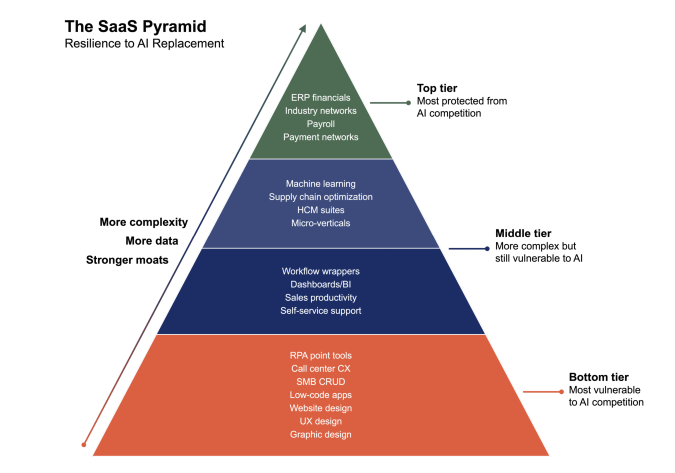
Smith arrives at the same destination from a different angle, with his own provocation: "AI will enable enterprise software to eat services"—an echo of Marc Andreessen's famous thesis that "software is eating the world," now updated for the agentic era. Where Phillips maps which segments of the SaaS market are most vulnerable and which are most defensible, Smith charts where entirely new value is being created. He sees AI-enabled software companies expanding into territory that previously belonged to human-delivered professional services, such as legal analysis, insurance underwriting, financial compliance, and customer success management. The TAM, the total addressable market, isn't just growing; it's being redefined. Smith estimates we're moving from 750 million software users to 8-10 billion software agents. That’s not only evolution. That's a phase shift.
Freedom Within the Framework
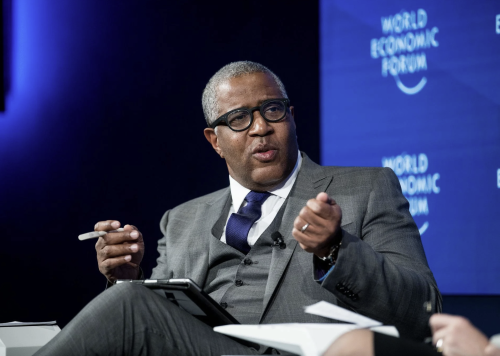
Robert F. Smith
Here's where Smith's analysis gets especially sharp, and where the leadership implications are elaborated. He draws a distinction between the probabilistic potential of AI and the deterministic workflows and outcomes that every executive, not just every CTO, needs to understand. Consumer AI can afford to be "mostly right," he says. You can tolerate a chatbot that occasionally books the wrong restaurant. Enterprise AI cannot. In banking, insurance, payroll, and regulatory compliance, "mostly right" is a liability. Smith argues that AI agents must be wrapped in proprietary data and enterprise software code with strict, deterministic business rules, legal guardrails, and security protocols to execute at enterprise scale. The companies that will win won't be the ones with the flashiest AI; they'll be the ones with the deepest workflow context and the most disciplined operational architecture.
This resonates with our work at the Jazz Leadership Project, where we discuss the relationship between Individual Excellence and the structures that enable ensemble performance. A seasoned jazz soloist doesn't just play anything out of the blue, so to speak; rather, their improvisations exist within a contextual harmonic framework, a rhythmic and melodic form, a set of shared cultural agreements that make freedom productive rather than chaotic. Smith is describing the same dynamic in technological terms. An AI agent, say, is the soloist. The deterministic software wrapper is the ensemble architecture. Without it, you get noise. With it, you can get performance at scale.
The Bottleneck Shifts
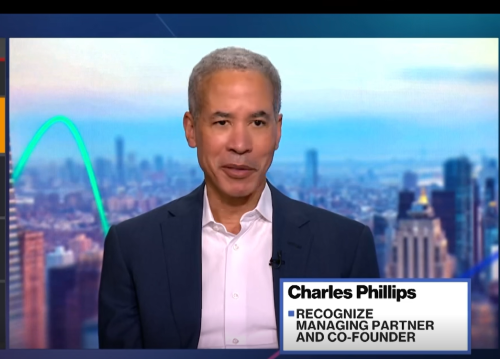
Phillips arrives at a related insight from the talent side. In his Recognize white paper, he observes that the software development role is evolving from writing code to system engineering: orchestrating components, designing for performance and security, and mastering prompts, agents, and inference. Domain experts can now become software developers without having to manually code. They can “vibe code” in the context window through narrative text. The bottleneck is shifting from technical execution to the quality of the idea. That insight has direct implications for how we think about leadership development and team effectiveness. When execution becomes commoditized, what differentiates teams is the quality of their thinking, the originality of their problem-solution framing, and their capacity to leverage and collaborate across differences to achieve outcomes beyond what any one individual can achieve alone.
The Morehouse and Spelman Question
Smith takes the democratization argument further and opens the way to a territory that matters deeply to us at JLP. His investments in generative AI curricula at HBCUs Morehouse and Spelman, his InternXL platform, and his consistent emphasis on closing the skills gap aren't peripheral to his business thesis; they're central to it. If AI creates massive productivity but only for those who already have access to elite tools and training, that widens the wealth gap. If AI is distributed broadly and intentionally, it becomes what Smith calls a way to "level the playing field." He's making an economic inclusion argument that is also, at its core, a leadership argument: who gets to participate in the transformation determines whether it's worth having. The epigraph above featuring a quote by media personality and political analyst Van Jones aligns with this position.
The Messy Middle Rewards Discipline
Both men caution against the extremes. Phillips warns against over-regulation that could kneecap American competitiveness. Smith invokes the "messy middle," acknowledging that we're in a period of noise and volatility, much like the early internet, where long-term value will accrue to disciplined operators focused on instrumental, business-critical applications. Both are leaders who understand that transformation is a process that rewards patience, precision, and strategic clarity.
Phillips and Smith — two Black American finance and technology leaders operating at the highest levels of enterprise software and investment — are offering a vision of AI that is neither a techno-optimist utopia nor a doomer dystopia. Their perspectives are grounded and operational, meeting this moment, which contains both great potential and peril, as thought leaders at their level should. From them, we can go past the question of whether AI will change everything. The evidence is clearly in the affirmative. The more trenchant question is whether the people, teams, and organizations navigating that change have the leadership vision and systems awareness to make it conducive to human flourishing.
And that's not just a question of technology. That's an Ensemble Mindset question.
This essay continues our ongoing series on leadership in the age of AI.