Why Ensemble Mindset Enables Human Flourishing in the Age of AI

Paradise podcast with hostess Ryan Michelle Bathé, Sterling K. Brown, and Dan Fogelman
At the end of his last post, Greg said: “The more trenchant question [regarding AI changing everything] is whether the people, teams, and organizations navigating that change have the leadership vision and systems awareness to make it conducive to human flourishing. And that's not just a question of technology. That's an Ensemble Mindset question.”
Precisely. What do we, as human beings, need to fully embrace to navigate the complexities and uncertainties of AI integration?
As we contend with AI speed, automation, unlimited productivity, and expansive knowledge, along with our role shifts or elimination, how do we move beyond the anxiety, confusion, and a sense of emptiness to ground ourselves in what author and historian Yuval Harari calls “the conscious creation of meaning”? Harari says that this is the first time in history we can choose our challenges and determine what is worth fighting for and preserving in order to create something greater than ourselves. He suggests that in this moment we can move from the expectation of one existential crisis after another to figure out what sets us apart and gives us meaning and purpose.
We believe that recognizing and cultivating the value of how we function and work together is critical not just to survive but to thrive.
In Rhythm Like A Jazz Band
Greg and I have enjoyed watching Paradise, a not-too-distant post-apocalyptic series on Hulu starring Sterling K. Brown, Julianne Nicholson, and James Marsden. Following each episode, Ryan Michelle Bathe hosted a podcast with cast members to discuss the evolution of their characters in a world with uncertain prospects of survival. Show creator Dan Fogelman was the guest for the final episode. Bathe asked Fogelman how he surpassed the first season to take season two to another level of storytelling and character development.
Fogelman said that the people he brought back for season two knew what they’re doing and even though it’s not solving world problems, they treat the job like it’s the most serious thing in the world—they care very much. Furthermore, they challenge him, because of the responsibility to serve audience expectations, to make the show even better.
When Bathe asked Fogelman about the evident depth of his relationship with Sterling K. Brown, Fogelman pointed to the mutual trust and respect of each other’s skill set. He said that they were in rhythm together, playing music together, like a jazz band that didn’t need to talk about what they were doing. Amen!
Ensemble Mindset is what Fogelman described in his answers, and is the system awareness Greg referenced. It’s also a superpower that frames intention, meaning, purpose, and connection.
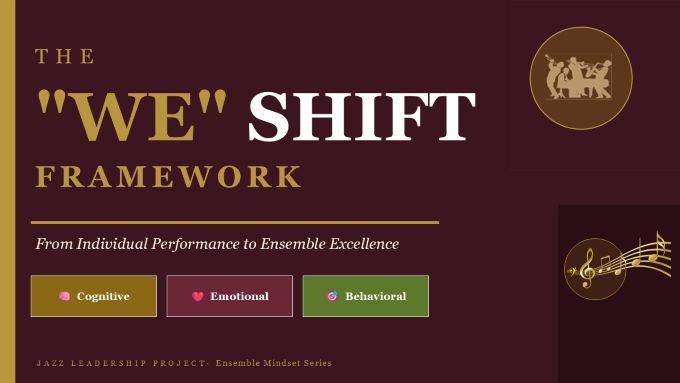
In our workshops we often say: In jazz, no single musician can produce the full sound of the ensemble alone. The magic happens in the space between players — in the listening, the responding, and the building together. Musicians function this way because of their love for the music and because they are attuned to each other.
Moving into an Ensemble Mindset requires adopting a “WE” framework through three shifts: cognitive, emotional, and behavioral.
The Jazz Mode: In jazz, a musician who only listens to themselves will throw the entire ensemble off. The moment you hear the whole band: tracking the bass line, the harmonic choices of the piano, the rhythmic conversation of the drums, your playing transforms. You are no longer performing at others; you are performing with them.
The Cognitive Shift asks you to make the same expansion at work: to measure success not only by your personal scorecard, but by the performance of the team you are part of. This is not about sacrificing personal excellence. It’s about understanding that your excellence is amplified when it serves the whole.
The Jazz Mode: When a band member plays something unexpected and beautiful, the other musicians don’t just note it and continue. They respond harmonically, energetically, emotionally. The ensemble is alive because each musician’s excellence genuinely moves the others. That emotional responsiveness is the group flow.
The Emotional Shift requires genuine generosity and the willingness to feel another person’s success as your own, not as a comparison, not as a threat, but as confirmation that the ensemble is working. This is the shift that builds psychological safety, and psychological safety is a proven foundation of high-performing teams.
The Jazz Mode: In a great jazz ensemble, each musician knows when to step forward and when to step back. A soloist doesn’t play over the entire song, they create space for the bass to breathe, for the piano to respond, for the drums to carry the groove. Shared Leadership is not a theory in jazz. It is the practice every single night.
The Behavioral Shift asks you to make this practice visible in your leadership: to actively design moments where others lead, present, and receive recognition. Not as a delegation of responsibility, but as an investment in the collective capacity of your team.
There is a radical grace in the co-creative intelligence of Ensemble Mindset. It is a high-level of interplay, where, when we define the areas we bring value that AI cannot, we have the ability to create meaning together.
Perhaps this moment can be viewed as a blank canvas on which we can intentionally create the space and the relationships that expand growth, value, and bring meaning to all we do.