
Meeting the Challenges of AI: A Jazz Leadership Approach
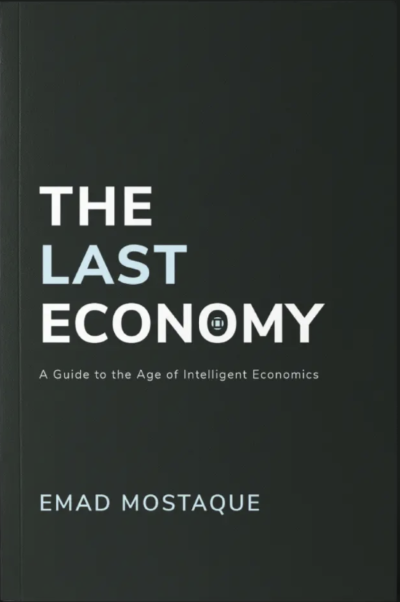
Over the holidays, I read The Last Economy by Emad Mostaque, a mathematician and former hedge fund manager who co-founded the UK-based AI firm Stability AI. In it, he presents a vision and plan for an abundance economy grounded in physics, AI, crypto, and the ultimate goal of human flourishing via a symbiotic relationship of AI computation and human consciousness.
The transition from a scarcity-based economy, with flawed measures such as GDP, to one of abundance is fraught with adjacent possibility risks, from what Mostaque calls "digital feudalism" and "the great fragmentation" to a 10–15-year dystopia of global instability, social conflict, and misuse of AI by bad actors as predicted by Mo Gawdat, former Chief Business Officer of Google X.
These challenges demand more than technical solutions; they require adaptive shifts in how organizations lead, collaborate, and innovate. In this continuation of our AI series, we’ll navigate this complexity through the four core principles of the Jazz Leadership Project (JLP): Individual Excellence, Antagonistic Cooperation, Shared Leadership, and Ensemble Mindset. These principles, which have enabled jazz musicians to manifest profound artistry and cultural intelligence while swingin’ in real-time, provide essential guidance for those seeking to realize Mostaque's vision of abundance while mitigating the dystopian pitfalls that threaten the transition.

Mo Gawdat
Individual Excellence: Mastering AI Fundamentals
Individual excellence is a foundation upon which effective AI integration must be built. As the JLP defines it, this principle embodies the disciplined focus and energetic effort to become better moment by moment, pursuing growth and mastery in life and work. In the context of AI and the transition to an abundance economy, individual excellence requires professionals to develop new competencies while deepening expertise in their domains.
In our case, Jewel and I have used our proprietary data and creative model as a competitive moat that generative AI LLMs, such as Anthropic’s Claude, can extend, elaborate on, and refine our research and strategy for client relationships and workshop content. (I also regularly tap into Gemini, Perplexity, and Manus.) This practice with AI has accelerated our workflows and greatly amplified our productivity and pace of creative insights. I spent a good part of 2025 going deep in the shed on AI, reading books, following experts such as Nate B. Jones, and listening to several hundred hours of podcasts and presentations. I view such work as foundational, similar to how jazz musicians practice long tones, scales, chord patterns, and song forms in all 12 keys. Over time, the disciplined application of such fundamentals, along with partnering with others striving for mastery, can prepare you to swing with AI.
Likewise, leaders and professionals must invest in continuous learning about AI technologies, data literacy, and the ethical considerations surrounding automated decision-making and the concentration of computational power that could enable digital feudalism. Knowledge can indeed be power if and when we exercise the taste and judgment to align AI development with generative human goals and objectives.
Antagonistic Cooperation: Growth Through Challenge
The principle of antagonistic cooperation, drawn from Albert Murray's hero's journey framework, recognizes that challenges strengthen us just as fire tempers steel. This principle is particularly relevant to AI implementation amid what Gawdat predicts could be a decade or more of global instability and conflict.
AI presents inherent antagonism to established workflows, job roles, organizational structures, and entire economic systems. Rather than viewing this disruption solely as a threat, antagonistic cooperation frames it as an opportunity for growth and innovation. The transition from scarcity to abundance economics will inevitably create friction, displacement, and resistance. Teams and organizations that embrace this principle can confront AI-related challenges with resilience, recognizing that the discomfort of adaptation can strengthen organizational and even cultural capabilities.
Antagonistic cooperation encourages leaders to welcome the "syncopation" that AI introduces into business processes and social structures. When AI reveals biases in hiring practices, inefficiencies in operations, gaps in customer service, or fundamental flaws in how we measure economic value through GDP, these discoveries should become catalysts for improvement rather than sources of denial.
Furthermore, antagonistic cooperation aligns with Carol Dweck's growth mindset, cultivating what Nassim Taleb calls "anti-fragility," in which systems thrive through uncertainty rather than merely survive it. This is why experimenting with AI tools, sharing failures openly, and iterating rapidly toward better solutions is key. Such a process builds the muscle of symbiotic collaboration, which, like the bass and drums in a jazz ensemble, provides the strong foundation necessary for wise spontaneity—improvisation. Such a balanced approach helps navigate between Mostaque's warning of "the great fragmentation" and the possibility of coordinated progress toward shared abundance.
Shared Leadership: Distributing Decision-Making Authority
Shared leadership recognizes and respects the inherent leadership capacity in all individuals while distributing responsibility and accountability for common goals. This principle directly addresses one of AI's most significant challenges: preventing the concentration of power that enables digital feudalism while ensuring rapid, distributed decision-making in complex systems.
Traditional hierarchical models struggle with AI implementation because effective integration requires cross-functional teams to make real-time adjustments to algorithms, data practices, and implementation strategies. In addition, teams and organizations must balance the orchestration of AI agents with cybersecurity, while striving for heightened productivity at increasingly lower computational costs. Shared leadership allows these varied perspectives to contribute and coordinate meaningfully through a flatter, more decentralized approach to decision-making flow.
Moreover, shared leadership in AI initiatives demands shared accountability for outcomes, including ethical implications, bias mitigation, and the equitable distribution of AI's benefits, as Mostaque describes it, via UAI: Universal Access to Intelligence. He practices what he preaches by making his book available for free, providing his AI-agent through open-source, and advocating for the decentralization of AI. This example is crucial: When responsibility and access are distributed across diverse stakeholders, more robust governance frameworks that catch problems early can be developed to ensure AI systems align with human values and the goal of universal flourishing rather than concentrated wealth and power.
Ensemble Mindset: Co-Creative Collaboration Through Collective Intelligence
Ensemble Mindset, which we describe as "Collaborative Co-Creation Through Collective Intelligence," represents the culmination of the previous principles and speaks directly to Mostaque's vision of a symbiotic relationship between AI computation and human consciousness.
An ensemble mindset in AI implementation conceives of technology not just as a replacement for human workers but as an additional voice in the organizational and cultural ensemble where the sum exceeds its parts through a multiplier effect. Just as jazz groups weave individual excellence with mutual support, AI-enabled organizations should integrate algorithmic capabilities with human judgment, creativity, and wisdom. The ensemble looks out for individuals' growth and welfare, ensuring that AI adoption enhances rather than diminishes human potential and agency.
This principle requires Big Ears, deep soulful listening, a core jazz practice, extended to include attention to AI system outputs, employee and citizen concerns, customer and community feedback, and broader social implications. An ensemble mindset fosters environments where, say, technical teams collaborate with ethicists and affected communities, where end-users help shape system design, and where collective intelligence guides strategic direction toward abundance rather than fragmentation.
Mo Gawdat also envisions an era of abundance but warns about the dystopic downward slope of the J-curve in the short-term. What can provide the cushion for a softer landing during the transition to the adjacent possible we call an abundant economy? Principles such as individual excellence, antagonistic cooperation, shared leadership, and ensemble mindset point a way to honor both technological possibility and human dignity.