
To Thrive in the Age of AI, Think Like a Bandleader
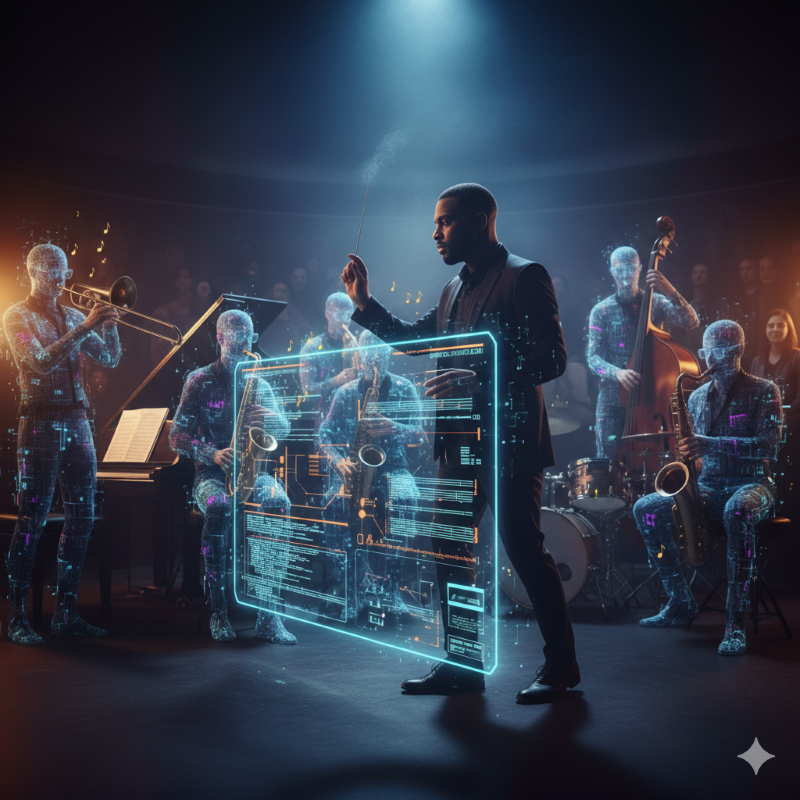
One key to not only surviving but thriving in the age of AI is seeing and thinking in systems.
I follow the daily Substack video posts of tech and AI influencer Nate B. Jones. Since the release of Anthropic's Claude Cowork, a desktop agent that can autonomously plan and execute multi-step knowledge work tasks on your computer, and OpenAI's Codex platform, a cloud-based software engineering agent that can handle multiple coding tasks in parallel, I've heard Nate say, time and again, that to manage the impact of AI on organizations and careers, a mindset shift is necessary. Since AI will increasingly handle the cognitive labor currently performed by people sitting at screens, a key human skill in such an environment is managing and orchestrating AI agents.
That reality became viscerally concrete with the viral explosion of Moltbot — now called OpenClaw — an open-source AI agent created by Austrian developer Peter Steinberger that recently went from a hobby project to a global sensation in just days. When thousands of people began downloading and deploying an autonomous agent built by a single developer in his spare time, it signaled that the orchestration challenge is no longer theoretical. Organizations and individuals are already navigating a world where AI agents act, decide, and execute on their behalf, whether they are ready for this shift or not. Steinberger himself joined OpenAI, a testament to just how seriously the industry is taking the autonomous agent moment.
Might orchestrating AI agents be similar to orchestrating a jazz big band or a classical orchestra? This analogy isn't just a nice artistic metaphor: it's a mental and visual bridge that helps us think in wholes, to better see systems.
Consider the classical orchestra. Its conductor has a score, a prewritten map of the entire performance. Every musician knows their part, their entrance, their dynamics. The conductor's job is to hold that totality in mind, synchronizing dozens of specialists so that the sum exceeds any individual contribution. Nothing is improvised. Coordination is everything. Clarity of role is a precondition for collective excellence.
Now, envision the jazz big band. There is still a leader—Count Basie, Duke Ellington, Wynton Marsalis—and still an arrangement, even if it’s a “head chart.” But within that structure, musicians are expected to respond creatively in the moment, to listen deeply across the ensemble in real time with Big Ears, to step forward when the moment is right and pull back when it isn't. Drummers don’t just keep time; they read the room. A soloist isn't just playing their part; he or she is in conversation with the rhythm section, with the audience, with the very moment and mood. The big band leader isn't micro-managing the players; they’re orchestrating a living, breathing system.
Both models point to what human leadership could become in an AI-driven era. When Nate B. Jones riffs on humans learning to orchestrate AI agents; he describes someone who can hold the whole picture in mind, direct multiple workstreams simultaneously, and tune in to how the parts interact and intersect. Yet since it’s now clear that AI agents will exercise agency to fulfill the objectives they’ve been tasked with, behavior that, for good or ill, can be deemed as improvisational, jazz orchestration, and big band leadership, may be the best model of the two. Especially since such leadership isn’t about command-and-control. Conceived as I’m imagining it, this metaphor is an application of systems thinking applied to human-machine collaboration.
Unfortunately, most organizations were not built to work this way. They were built on org charts, not ensemble maps. They were built to execute tasks, not orchestrate systems per se. And now, as AI agents take on more cognitive task execution, human work becomes coordination, attunement, and wise, soulful leadership. This is exactly the framework we've been building at the Jazz Leadership Project.
Aligning and Attuning the Human-AI Mix: From Metaphor to Method
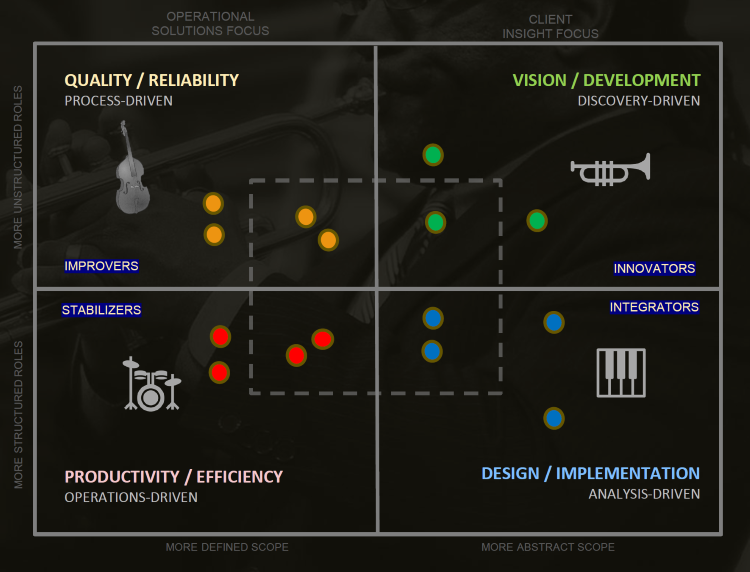
At JLP, we've partnered with our long-time colleague Mark Palmer to create a diagnostic tool — the Quality of Teams (QofT™) — that helps the organizations we work with see the structural and systemic forces driving their team dynamics. QofT™ operates on two interconnected levels:
The first is alignment: mapping every team member to one of four capability zones — Innovators, Integrators, Improvers, and Stabilizers — each corresponding to a distinct function in a jazz ensemble. Innovators are your soloists, vision-forward and discovery-driven. Stabilizers are your drummers, keeping operations grounded and efficient. Improvers are akin to bassists, maintaining quality and reliability. Integrators are your keyboard players, bridging analysis and implementation across the whole band. This alignment layer reveals the team's structural composition, who plays what role, where the gaps are, and where the ensemble may be out of balance.
But structure alone doesn't make music. The second level of the QofT™ is attunement — the relational and dynamic dimensions of how the team actually plays together. Are people listening across functions, or only within their own section? Is there trust, or just tolerance? Does the group move as a cohesive unit when conditions change, or do the parts fragment under friction and pressure? The attunement dimensions, grounded in jazz principles and practices, are inherently systemic: they can best be seen and addressed when you view the ensemble as a whole rather than evaluating individual players in isolation. Together, alignment and attunement give leaders a complete picture of their team's health and performance capacity and a roadmap for developing it through the Ensemble Accelerator, our team maturity process that moves organizations from diagnosis to sustained high performance.
When a team can see itself as an ensemble, structurally and relationally, and in operational and cultural terms, it can stop asking "who's in charge?" and start asking "who needs to step forward right now?" They stop optimizing for individual performance alone and start optimizing for collective flow.
These are the capabilities organizations need to navigate the AI transition well. The organizations and teams that will thrive are those with the human infrastructure to orchestrate those tools effectively. In a world where AI handles more of the execution and cognitive tasks, the premium is on humans who can hear and see the whole big band and know how to use the score as a basis for wise spontaneity for the sake of swingin' accord.
The question for leaders today isn't whether AI is changing the nature of work. Of course it is. The question is: are you ready to lead the whole ensemble?
This post continues our ongoing series on leadership in the age of AI.