
Glory: Where Home Becomes a Living Technology of Memory
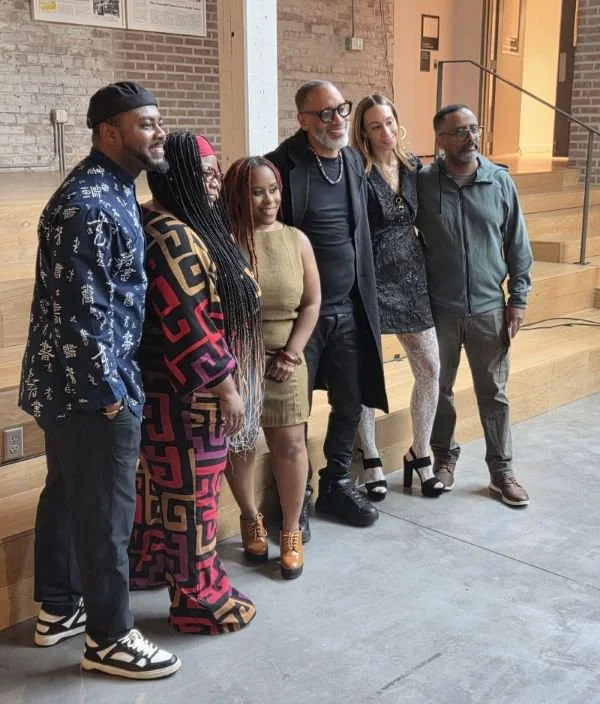
Faustin Adeniran, VantaBlack, Juanita Sunday, Shawn Theodore, Tara Fay Coleman, and Jomo Tariku
On Saturday, March 7, 2026, like a Janus-faced Eshu, the gallery opening of “Glory” at NXTHVN in New Haven, CT, transported me to the crossroads of an imaginal past and future of Black American life.
Upon entering, you look up to see the exhibit title. To the right, an iron security screen door leans against the brick wall. The artist VantaBlack, who created the artwork specifically for the exhibit, covered the iron door with synthetic hair braids and jewelry, later explaining that her professional braiding experience was an inspiration. Walking into the gallery, I see a plush, champagne-gold couch with matching pillows and two lace-crocheted doilies, like the kind I recall my Grandma Honey making in the ’70s.

Turning to the wall-text providing an exhibit overview, I read:
“What does how we arrange interior space say about how we live? And what does that say about who we are?” asks Elizabeth Alexander in her book, The Black Interior. To enter a Black home is to enter a space where visual language is intentionally constructed, shaped by care and self-definition, allowing complexity and identity to take form outside the demands of public gaze and institutional framing, as noted in bell hooks’ 1995 essay “In Our Glory: Photography and Black Life.”
Rooted in these concepts and expanded through a design experience, Glory honors the aesthetics of everyday survival and the ways working-class Black American families have built beauty, community, and meaning inside the walls that held them. Suspended between past and future, Glory transforms the gallery into an imagined Black American home interior and a living technology of memory. In this space, the home becomes an archive of care and imagination, where images and objects speak in the language of cultural memory.
Home as a “living technology of memory,” and an “archive of care and imagination”: an apt description not only of the exhibit but also the lived inner reality of idiomatic Black American kinfolk. The mixed-media artwork on display taps into a generative, generational nostalgia, providing continuity of imagination and aspiration to ground hope for tomorrow despite the wickedness abounding in our daily newsfeeds and the foolishness found on social media.
Inside the multi-use arts and creative center in the Dixwell neighborhood of New Haven, I feel safe, at home, my soul open and receptive. Artist Faustin Adeniran introduces himself to me, and we walk over to view his “L’intérieur du salon”piece, which he constructed from salvaged fragments gathered after a small house fire last year. He explained that his work involves sustainability and belonging, even if that belonging is grounded in the shared loss from last year's California fires. He points out his wife and beautiful young daughter, and then, when I mention my work in jazz, shares that Miles Davis and Thelonious Monk have inspired his aesthetic.
I sat on the couch, the first of three “Interactive Touch Zones,” leafed through a photo album featuring family photos from the 70s and 80s, and then turned the pages of a special-edition newspaper from 1974 featuring Elizabeth Catlett on the cover. Her story was titled, “Making Art Like the Blues.”
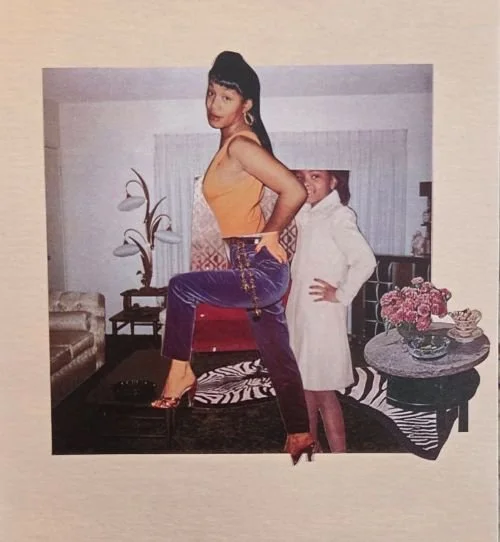
“Auntie’s House (I wanna be like you when I grow up!)”
I stand, walk around the table to face the couch, and peer into the three artworks above it. The first and third pieces are examples of “adaptive reuse” by Bria Sterling-Wilson, who draws on her family archives to re-present photographs in analog collage form. Their titles, “Auntie’s House (I wanna be like you when I grow up!)” and “Uncle Terrance,” take us inside her family, and prepare you for the works further down the space, “Joan’s Bedroom (Psalm 23) 1 & 2,” which show her beloved grandmother seated within the artworks, which are draped in the upper left frames by cloths with the verse, “The Lord is my shepherd. I shall not want.”
But in between Sterling Wilson’s aunt and uncle collage remembrance is a 2021 work, “Double Consciousness,” by Tyler Mitchell, which riffs on Du Bois’s concept from his 1903 classic, The Souls of Black Folk. We see a young man of dark complexion in a suit and tie; in the image on the left, he’s pointing a gun, a stereotypical image in which skin color overrides his careful sartorial designs. On the right, we see him studiously holding a thick book, seated crossed-legged. His self-image on the right meets the external gaze of racialized presupposition on the left, hence double consciousness.
Placing “Double Consciousness” between two familial images was a deliberate curatorial choice, suggesting that one’s self-conception and strong family bonds might mitigate the burden of the external gaze. Jomo Tariku’s “Meedo Chair,” seen to the right of these images and the couch, integrates Afrofuturism with a “retro aesthetic,” facing forward while looking back. He achieves this brilliant synthesis by reflecting two African symbols, a ceremonial seat and an afro comb, while also evoking the “Black is Beautiful” moment of the 1960s.
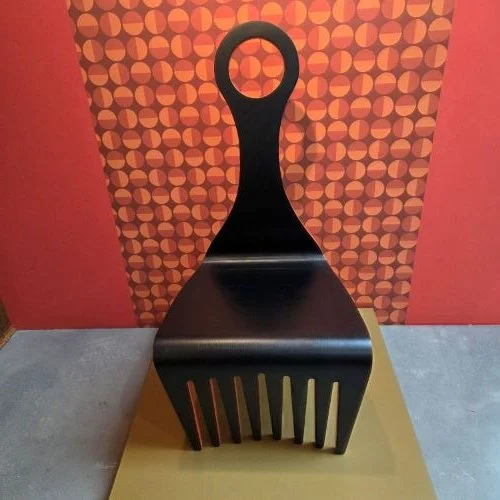
“Meedo Chair”
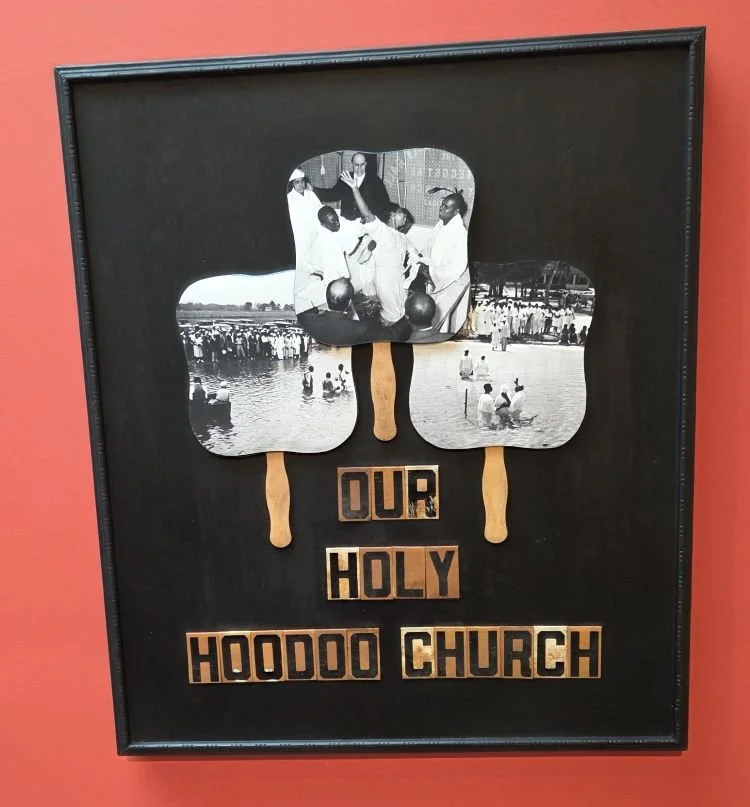
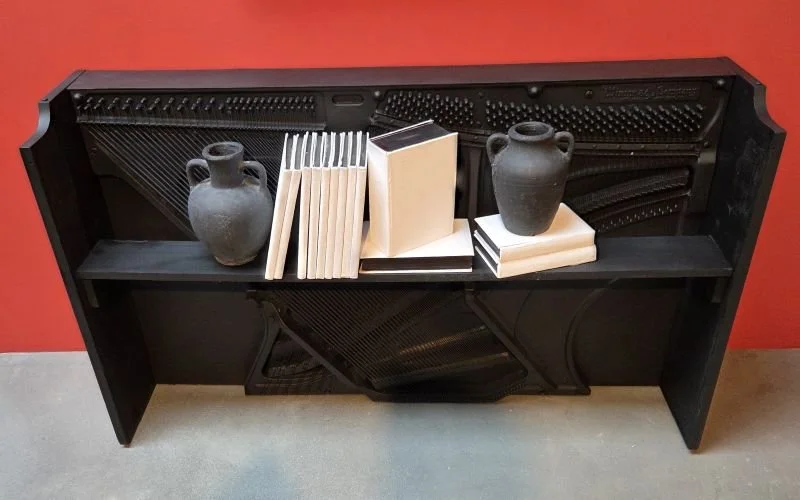
In four works that evoke myth and memory, spirituality and music, Shawn Theodore created portals, visual texts that, as he once said, “reimagine Blackness not as a monolith but as a living, breathing spectrum of myth, history, spirit, and self-definition.”His “Our Holy Hoo-Doo Church” honors the Southern Black American spiritual and cultural tradition of baptism, viewed on church fans, whereas the work directly below it, “Vibe (Resonance and Persistence),” uses a disassembled piano and arranged designs of books and vases to point to sources of steel-blue cultural power that affords our folk the capacity to keep on keepin’ on.
Two large works featuring women in repose serve as the centerpieces of the collection, Patrick Eugène’s “Alone with Dreams and Blooms,” a diptych six feet by six feet per panel, and Akea Brionne’s “Where the Body Lands,” a 48 x 120-inch textile diptych in which external gazes give way to rest and recuperation in a soul sista’s own space.
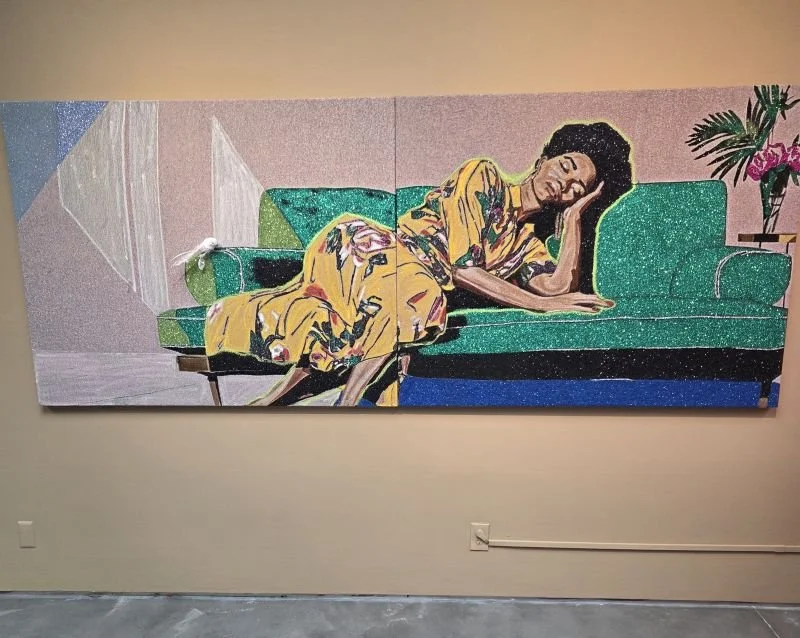
“Where the Body Lands”
Walking out of NXTHVN and back into the Dixwell afternoon, I carried with me what my mentor Albert Murray riffed on in South to a Very Old Place: home is less a coordinate on a map than a frequency you tune into whenever someone or something makes you feel that way. "Glory" operates on that frequency, asking us to remember that the doily on the armrest, the photo album on the coffee table, the shared rice and peas from the kitchen, the church fan tucked into a Bible are not mere décor but instruments of continuity, quiet acts of defiance against forgetting. In a cultural moment that seems intent, yet again, on flattening Black American life into stereotypes or spectacle, this exhibit insists on intersubjective interiority: the richness of the life lived inside the walls, on our own terms, in our own glory.
The Glory exhibit, curated by NXTHVN Curatorial Fellows Tara Fay Coleman and Juanita Sunday, lasts until August 30, 2026.
This piece was written in memory of my late colleague and friend, Greg Tate, whose knowledge of the visual arts far exceeded my own.