Prepare to be Surprised
When Greg and I facilitate in-person workshops, they typically address team issues regarding communication, silo mentality, or handling challenges. As such, we lean into the jazz practice of Big Ears and principles of Ensemble Mindset and Antagonistic Cooperation. It’s not often that we focus a workshop on the practice of Syncopation. This upcoming week, we will do just that.
Joined by our jazz trio, we’ll conduct a workshop for a group of Google VPs who are dealing with particularly complex challenges. We feel that shifting to syncopation allows us to reframe the unexpected through a lens and practice that enhances the ability to thrive through unexpected changes—not just survive or tolerate them. In the workplace, syncopation is the capacity to adapt fluidly to disruption, changing priorities, and unexpected rhythms while maintaining your footing and your focus with grace and effectiveness.
Off-Beats & Rhythm Shifts
In jazz, syncopation is the practice of accenting or emphasizing unexpected or off-beats. This practice enhances resilience and signals a readiness to manage change, which is a key quality for group cohesion. Jazz is a constant exchange: a conversation that brings new elements to light through the improvisational shifts that band members choose and express.
A jazz group doesn't play from a rigid score. They work from a shared structure, such as a key, a song form, a general tempo—but within that structure, the music is alive and constantly shifting. The drummer might push the tempo. The bass player might shift the harmonic center. The soloist might take the melody in an unexpected direction.
When one musician changes the rhythm, the others don't freeze. They don't panic. They don't keep playing the old pattern as if nothing happened. They listen, they adjust, and they respond together.
We like to say that jazz musicians are prepared to be surprised.
To give the VPs a different lens for handling the unexpected, we’ll demonstrate how, as a practical capability, the jazz practice of syncopation can reinforce the habit of reading signals and staying attentive to shifts. Jazz is an elegant container for the flow of polarities and, as such, syncopation plays with the dynamics of expectation/surprise and structure/freedom.
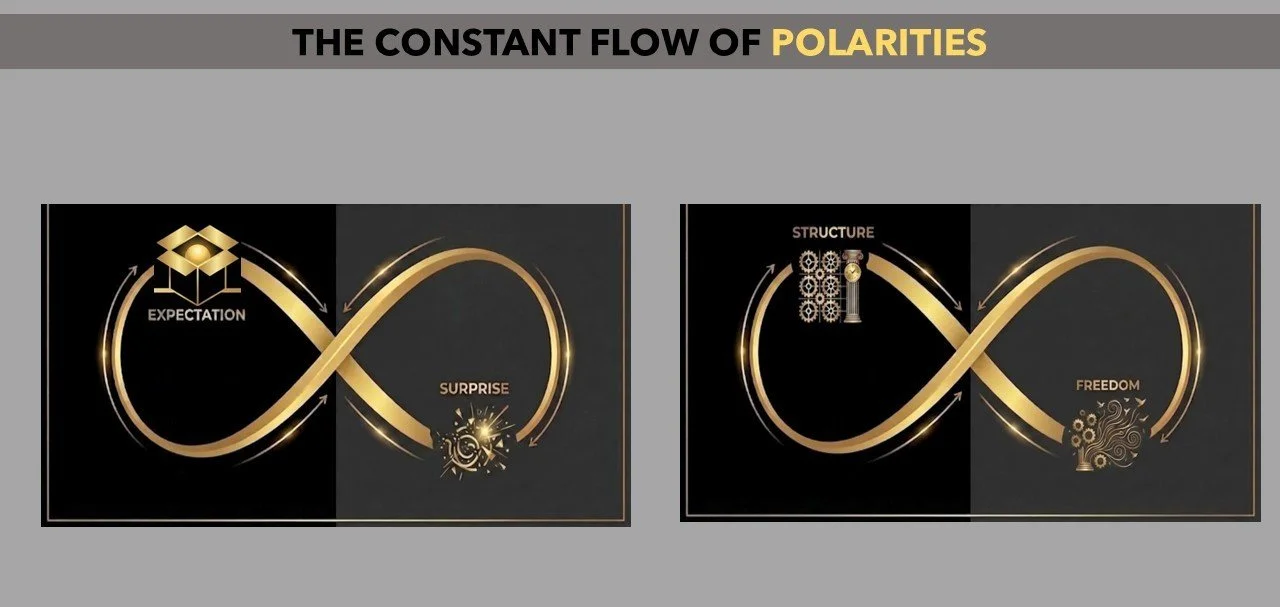
The Flow of Polarities
As a perceptual polarity, expectation and surprise describes the experiential tension between what a listener (or stakeholder, or team) anticipates and the reality that deviates from that expectation. This polarity lives in the relationship between the performer and the audience, or the leader and their ecosystem. The same musical phrase can be surprising or expected depending on what came before it. For leaders, this maps to the tension between predictability and disruption.
The structure and freedom polarity describes the architectural tension within any system, musical or organizational. It entails how a system is built and governed. In jazz, this is the relationship between the chord changes, key, melody, and time signature on one hand, and the freedom of the improvising soloist on the other. For leaders, this aligns with the tension between a framework and process and the freedom of flexibility and autonomy.
This dynamic is at play when leaders think about: How much latitude do I give? Where do I hold the line? Structure and freedom involve conscious trade-offs, org design decisions, and resource allocation. It's the kind of cognitive polarity you can map on a whiteboard, while expectation and surprise are felt before it’s fully understood.
A key insight from jazz: adaptation is not a solo act. Your ability to navigate change is deeply connected to your team's ability to navigate it collaboratively.
During any period of organizational transformation, the rhythm will change. Not just once, but repeatedly. Priorities will shift and structures will evolve. New expectations will emerge before the old ones are fully resolved. Transformation isn’t a single event… it’s an ongoing series of tempo changes.
The people and teams that navigate transformation successfully aren't the ones who avoid disruption or resist it. They have built the capacity to adapt and to recognize shifts early, to center themselves before responding, to recalibrate quickly, and to move forward with flexibility.
We look forward to the insights this jazz practice will bring to the Google VPs.