Why Trust Is Not A Luxury

Bassist Corcoran Holt and Drummer McClenty Hunter in workshop mode
This past week, Greg and I returned from a Google Cloud onsite in Sunnyvale, CA, where we facilitated a half-day workshop for a team of twenty leaders. With a newly combined group that tripled in the last month, the leader was energized to quickly build trust and cohesion while maintaining the speed and excellence it would take to support a 3X scale. As such, a primary objective of the workshop was to establish trust as an authentic, fundamental connection.
The group had a strong commitment to their collaborative goal, but in this nascent stage, they were still finding their footing to understand how they could work together successfully. The Managing Director was motivated to co-create a new culture that leveraged all strengths.
It was essential for them to view trust-building as a performance strategy, not something separate from their technical functions. Trust cannot be mandated, but it can be intentionally cultivated. JLP’s workshop provided the mindset and tools from the music for trust to emerge through shared experience, mutual understanding, and collaborative creation.
Shared Experience Creates Bonds: People who learn, discover, and create together form deeper connections than those who merely coordinate together.
Vulnerability Builds Connection: When members share their authentic selves—including uncertainties, questions, and areas for growth—it creates permission for others to do the same. Psychological safety emerges from witnessed vulnerability.
Co-Creation Builds Ownership: Co-created norms generate genuine commitment. Participants will co-design a culture that will guide their collaboration.
Trust is Not a Luxury
It is the foundation upon which all high performance is built. It is the architecture that allows speed, innovation, and sustainable excellence to coexist.
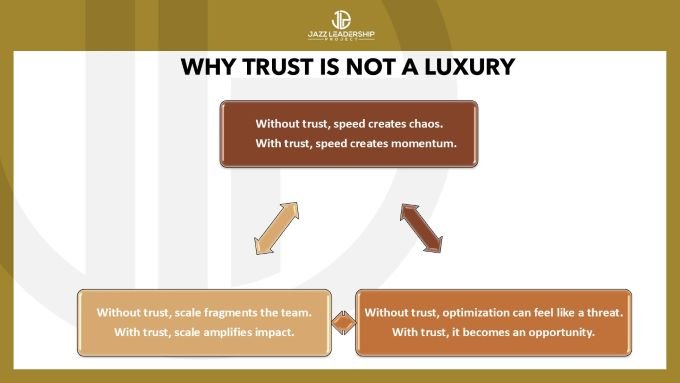
Without trust, speed creates chaos. With trust, speed creates momentum.
In jazz, musicians can improvise at breathtaking speed precisely because they trust each other completely. They can take creative risks because they know their ensemble will support them. They can disagree musically because that tension serves the music.
Without trust, optimization can feel like a threat. With trust, it becomes an opportunity.
An ensemble co-creates together what no one person can do alone. It’s not just efficiency, it’s swingin' harmony fueled by sustainable excellence.
Without trust, scale fragments the team. With trust, scale amplifies impact.
Neuroscience reveals that when someone is tangibly trusted, the brain synthesizes the chemical oxytocin. This neurotransmitter regulates social bonding, trust, and well-being. The more trust one is shown, the more the brain produces oxytocin which activates a brain network that makes us more empathetic. With more empathy, we can better understand how a person is feeling and why they do what they’re doing.
We set the tone for their ensemble development by establishing the critical need for developing trust. With this grounding, the workshop moved to the dual framework that builds and amplifies trust through Big Ears and Ensemble Mindset:
Big Ears, the practice of generative, multi-dimensional listening, creates the trust that makes Ensemble Mindset possible.
Ensemble Mindset, the fluid ecosystem of interdependence, creates a culture where Big Ears listening can flourish.
Together, they create collaborative high-performance.
Through targeted activities, the workshop catalyzed a fundamental shift—transforming the team's recognition that individual excellence drives collective success into an actionable operating principle, anchored in their commitment to deepen trust.