The Power and Beauty of Polarities
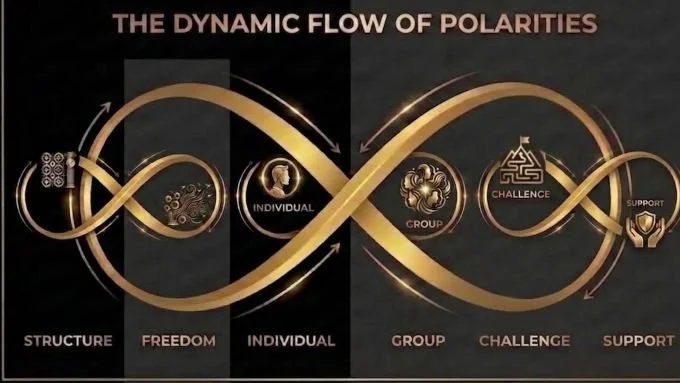
Last year, we facilitated a full-day workshop for a group of leaders at the California Institute for Integral Studies (CIIS). As we moved through the early framing of our cultural methodology, one of the administrators for the program noted the polarities that emerged for her. It was a seminal moment which led us to establish the dynamic flow of polarities as foundational to jazz and to our methodology.
Since then, we’ve facilitated several workshops for Google’s Leading Through Turbulent Challenges (LiTT) program. The complexity these VPs deal with in navigating their challenges prompted us to structure a segment of our workshop around the power and beauty of polarities in the collaborative flow of the music. Last October was the first time we presented the core polarities as contrasting elements that create productive tension and drive innovation: Individual ~ Group, Structure ~ Freedom, and Challenge ~ Support. I shared those in a post after the LiTT workshop.
It’s been exciting to bring to life a dimension that we had always mentioned, but never explicitly framed. We’ll be traveling to San Francisco at the end of this month to work with a new group of leaders at CIIS and look forward to sharing this expanded perspective.
Before heading to California, we’ll work with a group of fourteen VPs from a new client to help them clarify aspects of control and delegation. We see an opportunity to reframe this struggle as a polarity that can both strengthen leadership effectiveness and enhance empowerment.
An Engine of Jazz Vitality
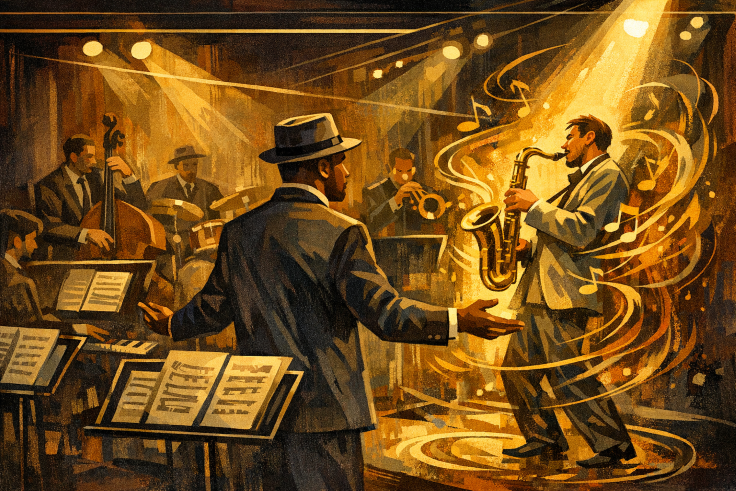
In jazz, a leader who only wants to control can produce a technically correct but listless performance. A leader who only delegates may produce inspired moments yet not cohere them into something larger than the individual. The art is in knowing when to cue and when to release, which means reading the room, the energy, the moment.
Control lives on the structure pole. These are the shared agreements that make collective improvisation possible rather than chaotic. A leader who exercises control sets the harmonic framework, cues entrances, and holds the ensemble to a tempo.
Delegation lives on the improvisation pole. It's the moment the leader steps back and gives the soloist the spotlight. The trust embedded in that gesture of: I've set the conditions, now express yourself, is an engine of jazz vitality. What makes this polarity rich in a jazz frame is that neither pole is the destination. The music lives in the movement between them.
In leadership, delegation and control can be viewed as polar opposites: one is about empowering others, the other about retaining oversight. But in practice, they are interdependent; neither can be fully achieved without the other, and both are necessary for effective leadership. Delegation shifts decision-making authority to team members, fostering autonomy, innovation, and skill development, while control ensures consistency, quality, and alignment with strategic goals.
When managed well, delegation and control form a both/and dynamic. The key is calibrated delegation, giving the right level of authority at the right time, with clear accountability.
Delegation is how a leader invests in individual excellence, creating the conditions for it to surface. Control is how the leader cultivates that excellence back into collective performance. The cycle between the two is what produces ensemble coherence over time.