
Learning that Less Is More, the Hard Way
From a basic maxim such as “less is more” to Shakespeare’s “brevity is the soul of wit” in Hamlet, the idea that the quantity of words and things is not as important as the quality of thought and concise focus contains wisdom. In our work with the Jazz Leadership Project, we learned these lessons the hard way.
Over the course of this newsletter, which began in late 2019, we’ve often referred to the praxis of our model, in which four first principles grounded in jazz music give rise to six practices.
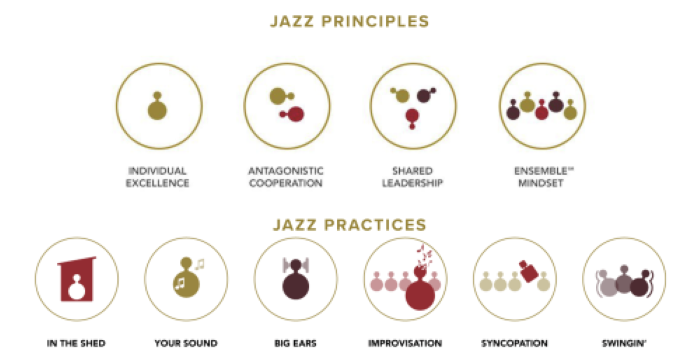
Nearly a decade ago, as we extended and elaborated on the metaphor of the music and jazz musicians as exemplary of soulful leadership and team effectiveness, we designed our model to reflect what jazz is and does. We took pride in the design, which we believed balanced the polarity of individual and group dynamics in a felicitous way.
So, in pitches for business and in virtual or in-person workshops, we’d often begin by sharing and explicating what you see above. Yet we came to discover that this scaffolding was perceived, in more cases than not, as a professional version of TMI: too much information. We thought it was necessary for prospects and clients to see the model's holistic foundation, then focus on the specific jazz dimensions needed for the situation.
Why we stopped showing prospects and clients the whole framework
The feedback was rarely direct. It appeared as polite interest that did not convert, glazed eyes around the third or fourth practice, the question that signaled someone had stopped tracking two slides earlier. We kept refining the explanation and even pared down the model's intro presentation to a few minutes, yet the problem remained: the volume and scope of information.
Miles Davis and John Coltrane
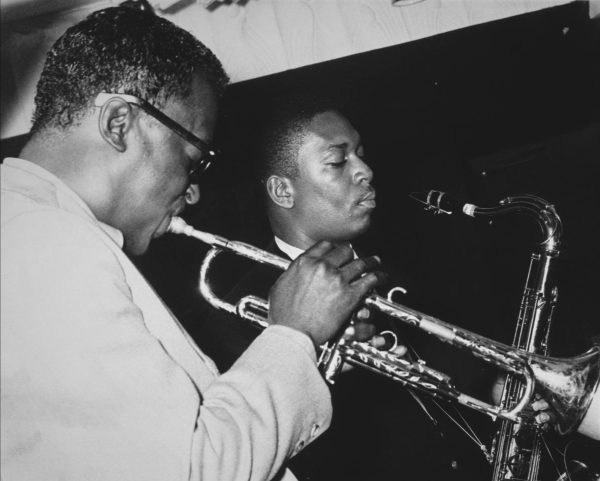
This is the centennial year for both Miles Davis and John Coltrane. Once, Coltrane was frustrated and approached Miles. As a key member of Miles’ first great quintet in the 1950s, he confessed that he did not know how to stop once he got going in a solo. Miles' reply, which has come down to us in more than one form, included this: you don't have to play everything you know in every solo. He also reportedly told ‘Trane to try taking the horn out of his mouth! Miles was not telling him to know less. He was telling him that real-time editing is part of music performance and audience reception.
That was our problem. We were not over-prepared. We were overplaying.
Once we realized this, we redesigned how we presented, started leading with one or two principles or practices as the situation called for, and kept the rest offstage until needed. Managing the challenges and conflicts of cross-functional coordination: Antagonistic Cooperation. A leadership team where every decision is routed through one person: Shared Leadership, with Big Ears as the practice to enable the development of Ensemble Mindset. A director whose cultural background led him to give the team all the credit, rather than embrace his crucial leadership role in the team’s success: Your Sound. The full model remained as the cultural and spiritual foundation and inspiration, while our pitches and presentations became more centered and concise.
This change has allowed us to accentuate the interactive experience in real time over the need for pedagogical rendering.
There is a temptation, with any framework you have spent years developing, to display the whole thing as evidence of seriousness. The framework took years, and the music itself took decades to evolve. But a listener has fifteen minutes before starting to tune out. Jewel and I had to learn that our prospects were not auditioning the architecture. They were trying to hear whether we understood their problem.
This lesson has only sharpened in the current moment. The supply of frameworks, decks, and AI-generated synthesis is becoming omnipresent. Attention is not. What separates a useful contribution from noise is rarely the depth of inventory. It is the discipline to choose the right note in service of the organic power of the music itself.
Miles was a wise leader of musical ensembles. He understood, sooner than Coltrane, that knowing and playing are not the same thing. Less is more, finally, because more can be a way of avoiding the hard work of choosing. As Blaise Pascal once said, “If I had more time, I would have written a shorter letter.”