
Ryan Coogler’s "Sinners": The Blues Hero in a World of Shadows
The blues idiom isn’t just a musical form; it’s an existential orientation toward life itself. Blues music points to perpetual ways to confront catastrophe with style, resilience, and elegance. Ryan Coogler's Sinners (2025), the most nominated film in Academy Award history, is a contemporary vessel for these classic Afro-American themes, embedding the blues aesthetic into its Mississippi Delta nightmare. Set in 1932 Clarksdale, the film transforms the vampire genre into a meditation on Black American resilience, presenting twin protagonists, the Smokestack twins, both played by Michael B. Jordan.
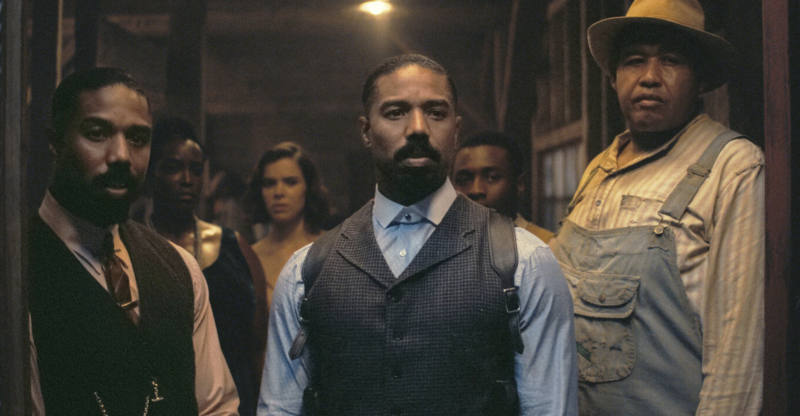
Sinners’ main cast members
Dragons and the Necessary Antagonist
In The Hero and the Blues, my mentor Albert Murray argued that the hero's antagonist, the dragon, is the very condition that makes heroism possible. Smoke and Stack embody this principle. The twins return to Mississippi from a stint in the Chicago underworld after serving in World War I, seeking profit and pleasure through a juke joint. But they confront layered dragons: Jim Crow violence and segregation, vampires seeking to suck the blood out of their culture, and their own troubled pasts as bootleggers, vets, and as men who left behind the women they loved.
What makes Smoke and Stack blues heroes rather than tragic victims is their refusal to be defined by these antagonisms. They don't seek escape from complexity; they rather engage with it, strumming the pain. When vampires emerge as literal embodiments of the region's parasitic violence, providing a twist on the classic blues line, “In the evenin’, when the sun goes down,” the twins don't flee—they improvise, adapt, and fight back, at least until Stack is transformed after being seduced and bitten by the tragic mulatto Mary, who herself has succumbed to the vampire’s wiles and become a succubus.
Ralph Ellison described the blues as "an autobiographical chronicle of personal catastrophe expressed lyrically," kept alive in one’s aching consciousness by fingering the jagged grain of its tragi-comic memory. Sinners makes this literal through musical witness. Delta Slim (Delroy Lindo) recalls the lynching of a fellow bluesman while riding down a highway with Stack and Young Sammie (Miles Caton), known also as Preacher Boy. Delta transmutes the pain and tragedy of the memory by humming blues riffs that transcend the divisions of the sacred and secular by springing from his very soul. Sammie is torn between the church that his father wants him to be devoted to and his love of playing acoustic guitar and singing the blues. He experiences a catastrophe that very night at the juke joint, but by the end of the film, sixty years later, it’s clear that he has survived in and through the music.
The Sacred-Secular Synthesis
The juke joint at the center of Sinners demonstrates the false binary between what Murray in Stomping the Blues called the Saturday Night Function and Sunday Morning Service. These aren't opposing forces but complementary expressions of the same life-affirming impulse in the Afro-American cultural continuum. The juke joint and the church were both spaces where Black folk confronted existential dread through ritual, rhythm, and collective transcendence. One sanctifies through the spirit; the other, so to speak, through the spirits. Both are ways and means to stomp the blues, at least momentarily.
Coogler shows this truth viscerally. The film's extended music-making sequences aren't mere entertainment—they're ritual spaces where community forms, trauma processed, and meaning made. The movie's pivotal centerpiece is the six-minute one-shot montage in which Sammie’s singing and playing the blues pierces the veil between the past and the future, conjuring the dance-beat origins of Africa and the folk hoodoo tradition while portending the extensions and elaborations of the blues in rock, soul, and even hip-hop. Coogler also includes Asians and Native Americans in his Omni-American mix.
When Sammie sings, when Delta Slim plays, and the community dances together, they're not escaping reality; they’re fortifying themselves by transforming suffering into sound. The devilish vampires that invade this space represent forces that have always sought to destroy Afro-American joy, autonomy, and self-determination. The Saturday Night Function becomes a form of resistance precisely because it refuses to concede that life under oppressive conditions must be lived in perpetual mourning. The community in the juke joint fought valiantly in the ever-present battle of good vs evil.
Moral Complexity and Resilience
My late friend Stanley Crouch insisted that the blues idiom rejects victimhood in favor of a tragic-optimism that transforms suffering into art through sheer force of will. Sinners explores this dynamic through rounded, morally complex protagonists who are bootleggers and criminals yet also dreamers and community builders. The film refuses to sanitize them into respectable heroes or reduce them to tragic victims. They exist in that blues space between Saturday's so-called sin and Sunday's salvation, neither wholly damned nor wholly saved.
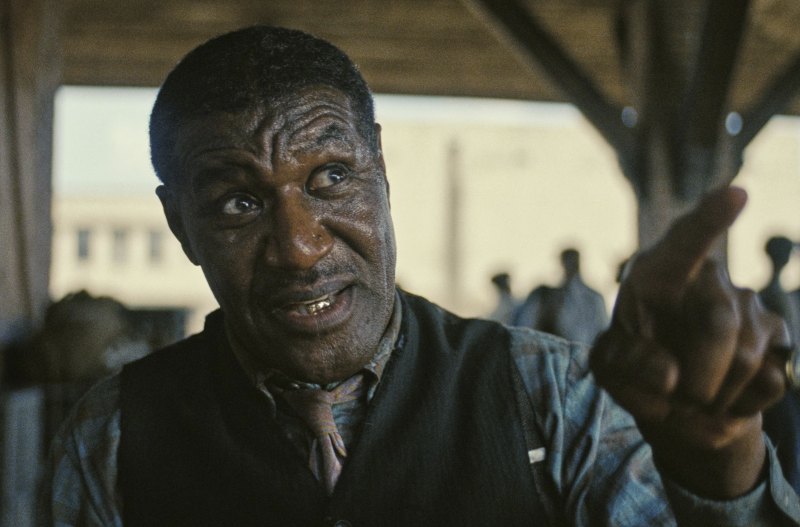
Delta Slim (Delroy Lindo)
Delta Slim represents this duality. As an elder bluesman, he carries the scars and wisdom of both Saturday and Sunday and sacrifices himself during the film so the community might survive. Young Sammie represents the tradition's continuity—proof that the blues idiom is transmitted across generations through lived example and shared struggle. Together, these musical witnesses frame Smoke and Stack's journey, showing that the twins aren't isolated heroes but part of a continuum of blues resistance that ultimately transcends good and evil.
The film doesn't offer easy redemption or triumphant victory, but neither does it indulge in nihilistic despair. Ludwig Göransson's blues-saturated score provides what Murray, borrowing from Kenneth Burke, called "equipment for living." The blues can't eliminate the vampires; yet it gives the community a language and rhythm for fighting them, a way to maintain humanity in inhuman conditions.
Outchorus: Stomping the Blues, Defying the Darkness
Sinners contributes to the ongoing blues narrative of American cinema by refusing to separate horror from history, entertainment from testimony, style from survival. Coogler demonstrates what Murray, Ellison, and Crouch all knew: the blues idiom is not about wallowing in suffering but transforming it into something usable, even beautiful. The Moore twins, framed by Delta Slim's wisdom and Sammie's journey, respond to chaos and entropy through what Murray called "affirmation in the face of adversity," striving to swing for as many bars as you and they have got.
These characters prove that even vampires can't drain what the Saturday Night Function keeps replenishing: the will to make meaning, to create beauty, to insist on one's humanity in circumstances designed to deny it. This is the blues hero's eternal victory: not escape from the dragon, but the elegant solution that transforms confrontation into art, Saturday's sin into Sunday's salvation, and darkness into antifragile sound.