
Beyond Common Ground: The Higher Octaves of American Identity
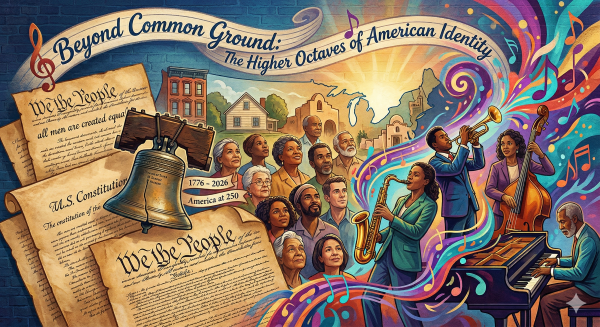
America turns 250 this year. No doubt, it’s a milestone for an experiment in democracy like none other in human history. The fireworks will come, along with the speeches invoking the founders and our first principles. But beneath the celebrations, it’s important to ask what, exactly, we are commemorating. Certainly not a finished achievement. Perhaps it’s that a nation this expansive and various, this perpetually at odds with itself, can nonetheless hold together.
At the biological level, we are nearly identical. The Human Genome Project settled that question definitively: we are, as a species, far more alike than different. The harder question is why that fact changes nothing.
Why can't we translate that commonality into cohesion? Of course, we get tripped up by our differences.
That’s where identity comes in. For the last few generations, “identity politics” has come under fire, and rightfully so. Playing politics with categories that are either unchanging or fluid is like cutting our collective noses to spite our faces—it’s a temporary response to a current or immediate predicament, but, ultimately and in retrospect, that narrow approach won’t take us where we need to go.
Yet, identity itself is fundamental to human existence. Who am I? Who are we? Perennial questions.
For instance, just who are we as Americans? And on what basis might we actually claim each other? Our differences as Americans are more than skin deep.
On the vast, sprawling North American continent, our differences are evident by region. Our differences are political, as demonstrated by the last few presidential elections, in which hyperpolarization became even more entrenched. If there is to be a shared national identity, it won’t be based on region or political affiliation.
Neither will it be based on ethnicity, nor, certainly, on race, two social categories that highlight difference far more than commonality.
Neither can it be based on economic status, especially given vast wealth differentials, where each succeeding generation no longer expects to rise in economic standing beyond the previous one.
Don’t get me wrong: yes, we share a liberal democratic capitalist system based on the concept of free enterprise, which I view not only in economic terms. Free enterprise is, as Albert Murray once put it, “an experimental attitude, an openness to improvisation.” As a second-generation entrepreneur who has successfully raised capital and built a business that sustains my family, I am a beneficiary of that system.
However, let’s reason together. On one hand, crony capitalism chokes competition through monopolistic or oligopolistic behavior in the market; on the other, the combination of unfettered market power held by a handful of technology companies and the current transformation of the economy and workforce by AI may very soon wipe out entire categories of work.
Common ground, in other words, won’t be found in the marketplace.
So, on what basis can we base an American identity we can share beyond our many differences?
The first place is in our nation's first principles. Where are those principles found? They’re found, first, in what Ralph Ellison called our sacred documents: The Declaration of Independence, the Constitution, and the Bill of Rights. Many point to the hypocrisy of the founders, who not only didn’t live up to those principles but also violated them egregiously by being slave holders.
I won’t excuse the founders for that fact. But neither will I engage in presentism—judging them solely by the standards of today—nor will I equivocate on the power of the vision they enacted, a democratic magnet for people all over the world, especially those living under tyranny, despotism, and authoritarianism.
I will not apologize for embracing democracy and democratic principles as superior, in terms of human freedom, to the competing systems I’ve just mentioned. So, the primary principles of the nation, if viewed as founding values and grounding ideals that inspire us to keep working and striving to make them increasingly real, could and should be a source of common ground for all American citizens, no matter our differences.
Yet the common ground of our liberal, humanistic values, these days, doesn’t seem to be enough. We also need higher ground, higher octaves of transcendent meaning and value. The dominance of scientific and technological development outpacing our moral imagination and capacities, not to mention its eclipsing of myth and religion, is leaning toward a technological and economic elite controlling the AI algorithms that could surveil our daily lives. Bye-bye privacy. That’s one of several possible futures whose dystopic potential frightens.
That higher ground, I contend, has always been available to us, not in our institutions alone but in our vernacular culture. America's most enduring and democratic musical form, the blues idiom and its most sophisticated expression in jazz, is a tradition built precisely on the problem this essay is wrestling with: how do you make something coherent and beautiful out of radical difference, conflict, and competing voices? The answer the music gives isn’t an erasure of difference but its transformation. Not unanimity, but rather, the real resonance of E Pluribus Unum, an ensemble whole. Not the suppression of individual voices, but what Ralph Ellison called a “stern discipline” in service of the dynamic complexity of American life.
That is, in microcosm, a democratic ideal. Albert Murray called it Omni-American: the recognition that American identity exists not despite its African, European, Indigenous, and immigrant convergences, but because of them. Likewise, the blues didn't arise in spite of America's contradictions. The blues idiom developed with and through them. The Omni-American isn’t a utopian projection; it’s a cultural fact we have yet to fully claim.
A culture that takes seriously its own vernacular wisdom — the tragic optimism baked into the blues, the improvisational daring of jazz, the call-and-response at the root of our civic life — is a culture equipped to meet the algorithmic future without surrendering its humanity to it.
Common ground may be where we start. But the higher octaves, such as art, aspiration, inspiration, and the willingness to improvise toward a more perfect union, are where we might, if we choose to, actually arrive.