
When the Machine and AI Agents Solo
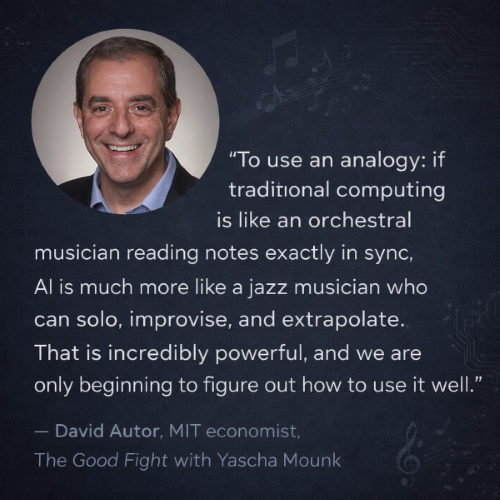
On Yascha Mounk's podcast this past March, MIT economist David Autor proposed a comparison that caught me off guard. Traditional computing, he said, is like an orchestral musician reading notes exactly in sync. AI is closer to a jazz musician who can solo, improvise, and extrapolate. He added a caveat: we are only beginning to figure out how to use it well.
The analogy felt fresh when I heard it come from Autor's lips. Yet the comparison isn’t new in the literature of work and leadership.
About three decades ago, management guru Peter Drucker was telling executives something similar about their organizations. The command-and-control model, he wrote, resembled a 19th-century army or a strictly conducted symphony, and it was becoming obsolete. What replaced it would look like a jazz combo. Players would share a lead sheet rather than a strict score. The "man at the bottom," in Drucker's phrasing, often knew more about the work than the CEO did, which meant he needed real authority to make decisions on the spot. The manager's job shifted from conductor to producer: get the right talent in the room, then ensure the groove remained productive.
Thankfully, Drucker also corrected a popular misreading. As readers of this newsletter know, jazz is far from random. Indeed, the jazz idiom is no less disciplined than European orchestral performance; the discipline of live jazz performance can be more exacting because the players must listen to each other closely enough to adjust and adapt in real time. The freedom of the soloist depends on the attentiveness of the rhythm section. Without such deep, soulful listening—Big Ears—freedom can collapse into formless drift.

Warren Bennis
Warren Bennis, Drucker's contemporary, peer, and leadership studies pioneer, was making a parallel case. "I used to think that running an organization was equivalent to conducting a symphony orchestra," he once wrote. "But I don't think that's quite it; it's more like jazz. There is more improvisation." Where Drucker focused on structure, Bennis focused on the psychology of the person in charge. He wrote about "the sound of surprise," a phrase the late New Yorker writer Whitney Balliet used to describe jazz, as the working condition of leadership in a turbulent age, and about leadership in a shared, distributed context. The "top dog," so to speak, becomes whoever has the best idea in the moment. Most pointedly, he said leaders had to give up what he called the "omniscient and omnipotent fantasy," the ego-driven belief that the person in charge has to know everything. Mistakes, in his framing, were riffs that had not yet found their way back to the melodic and harmonic form.
Miles Davis said it best: "It's not the note you play that's the wrong note—it's the note you play afterward that makes it right or wrong."
So, there’s a two-generation intellectual tradition arguing that organizations should function more like jazz ensembles. And we have a 2026 economist arguing that AI itself now functions more like a jazz musician than an orchestral one.
I find this fascinating because Drucker and Bennis were writing for ensembles made entirely of human beings. The soloists in their analogy were knowledge workers. The improvisation was a metaphor for human judgment and execution under uncertainty. Autor's analogy lands in a different age. The new soloist in the band is a machine model that extrapolates and elaborates fluently in registers that once required years of human apprenticeship.
If the machine can solo, what are humans for?
One of the answers sits in the part of Drucker's argument that most miss. Jazz is not a competition between soloists. Jazz is an exercise in mutual attention and call-and-response feedback. A solo is interesting because the rhythm section serves as a stabilizing anchor, where the other players tune in for the moment to push back, lean in, or drop out. The improvisation carries weight because the ensemble has agreed on freedom within the form and cooperation within the challenge.
Given the proper context and guardrails, an AI agent can produce a passable solo. It cannot, and should not, take responsibility for the groove. They don't read the room. They don't notice when their own riffs have gone off the rails, when the bassist is tiring, when the drummer is signaling a change. Those are the duties of an ensemble member. The ensemble mindset, in other words, is also the leadership mindset.
One might assume that Autor's analogy might make Drucker and Bennis sound dated. Au contraire. Drucker and Bennis’s take is even more useful because Autor sharpens and reinforces their points. The question has moved past whether human organizations can learn to improvise. Some of the soloing will now be done by agentic systems, whether we want it or not. The point is whether the humans in the room can do what jazz artists have always done: listen soulfully enough for the music to hold together when the soloist takes off.
That, along with earned judgment and cultivated taste, is the work. It always has been. It’s just easier to see what is at stake now that the soloist in the corner is a machine and the groove is still ours to keep.
This essay continues our ongoing series on leadership in the age of AI.