The Architects of Radical Grace
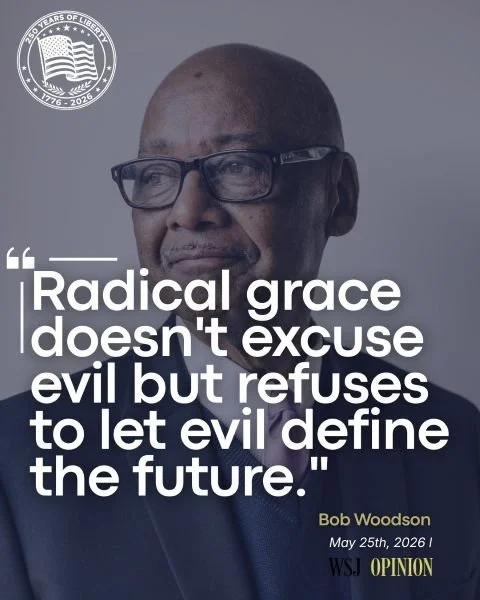
Image from the Woodson Center’s newsletter
On May 19, visionary and civil rights leader Robert Woodson passed away at 89. For over four decades, he built his life's work around a single, tenacious conviction: that the people best equipped to heal a broken neighborhood are not distant policymakers, but the neighborhood's own "social entrepreneurs." These are the people who choose to rebuild from inside the wound rather than wait for someone else to fix it.
Days after his death, the Wall Street Journal ran his final piece titled "The Architects of American Renewal," summarizing his legacy: our country still needs leaders who don't nurse grievances but choose the path of radical grace. The Woodson Center is dedicated to Woodson’s vision of and to empowering the grassroots leaders he called “the architects of American renewal.”
Woodson’s article brought me back to the radical grace I’ve written about in previous posts. I shared stories that had nothing to do with policy and everything to do with a single human being deciding, in a moment that offered every justification to do otherwise, to respond with something larger than the offense in front of them.
There was Kaylah Spring, a college freshman who stood before a crowd and named herself rather than let her attacker's cruelty define her. There was Mickey Guyton, answering a racial slur with "God bless you." And Jacob Blake Sr., who felt he had to remain humble after his son’s violent death. Each chose grace over grievance, responding with discipline, responsibility, and moral courage. Neither of them was waiting on an institution.
That word chose is the pivot point. In Relational Grace, I pushed back on the idea that people who respond this way are just performing what's expected of them or acting out of fear. They're not. They're acting from agency, what I call a "soul force," that stands in the truth of who they are and chooses connection overreacting in-kind. That is precisely the distinction Woodson spent his career defending on a civic scale: that grace is not weakness or submission, it is the harder, stronger choice, and the people who make it are not passive, they're architects.
Woodson wrote: “America was founded on ideals intentionally left unfinished. It’s true greatness lies not in claims of perfection, but in its constitutional capacity for self-correction. The painful struggle to live up to those ideals takes courage, self-discipline and, above all, grace.”
Here's where I think Woodson's passing, coming just weeks before our nation's 250th birthday, hands us something to carry forward. His argument was about what happens to a country whose story gets told only through its resentments, fomenting a people who come to believe they are permanently defined by their worst chapters, until the belief itself becomes the ceiling on what they can build. The renewal he spent his life pointing toward didn't come from the top down. It came from ordinary people, who chose to act from strength instead of injury.
That's the measure I want to add to what I've already written about grace. Kaylah and Mickey aren't just moving anecdotes, they are, in Woodson's language, the architects of renewal. And if the last 250 years have taught us anything, it's that our next chapter won't be written by institutions alone.
“As America turns 250, the question is whether we still possess the spiritual resources to renew ourselves,” wrote Woodson. “Will we continue nursing our grievances, or will we choose the harder path of radical grace? America’s future depends on that choice.” Woodson would say that the choice is ours. Mine. Yours. One chosen act of grace at a time.
What would it look like if the same grace we practice in our hardest personal moments became multiplied a million times over and the architecture of national renewal?